Some years ago I took a party of Italian architects and politicians on an architectural tour of the Borough of Camden, and its impressive examples of modern housing. Visiting Highgate New Town, I happened to mention Highgate Cemetery, and suddenly nothing would please the group but that we should visit Karl Marx. The cameras came out; the Communists among the party struck up heroic poses in front of the famous, ugly slab of granite, while the Christian Democrats laughed and joked on the sidelines. A public sculpture doesn’t get the same response from everybody.
When taking students around the National Gallery I used to get impatient with tourists who pushed in to take selfies in front of some famous painting. If they weren’t going to look at the picture itself, why not just download a copy from the internet, and save the trip to London? But I do now accept that there’s something of value about a selfie taken in front of ‘Les grandes Baigneuses’ or ‘The yellow Chair’. In a way it’s an attempt to create an association, even a tenuous dialogue, with the painting. In weaker moments I confess that there’s a sort of compulsion to be photographed in front of an object that has some meaning for you: in my case, for example, Le Corbusier’s Ville Radieuse in Marseille. And as for statues, I’ve faced the camera alongside Garibaldi in Venice, Jean Jaurès in his home town of Castres, and Gary Sobers in Bridgetown, Barbados.
There’s a lot of argument today about statues - though statues are only part of the real issue: that of the demeaning and deadly institutional racism of many societies. But as Marx says, ‘the prevailing ideas of any age have always been those of the ruling class’. Ever since the portrayal of Egyptian Pharaohs as gods, public art has always made a contribution to the dominant ideology which sustains class hegemony.
Bourgeois historians emphasise the role of the ruling class in the story of human development, and their public monuments reflect this. Just as we need to uncover the alternative histories which tell of the vital contribution which ordinary people have made to social change, so do we need to stop celebrating kings, generals, mill-owners and slavers, and focus more on the rest of society. Less attention should be given to the privileged individuals who made money and more to the communal struggles which achieved changes for the better. And we should celebrate them, I suggest, not with statues but with almost anything else.
The dead faces, empty eyes and rigid poses of bronze statues, whether of Edward Colston or Winston Churchill, are bourgeois things. A solid, permanent statue implies the rightness and longevity of the society it belongs to - things were always thus and things will never change. And even when progressives, like Nelson Mandela - whom Margaret Thatcher called a ‘terrorist’ - are eventually admitted to the pantheon, the implication is that the bourgeois state is enlightened and magnanimous, able to subsume progressivism into its overall narrative.
As we understand them, memorials are historical. Even the Cenotaph in London, which renews itself as a national focus every year, is only about the past. Fine words such as ‘never again’ are spoken, but there is never a discussion about how wars might be avoided in the future, nor any practical steps taken to try to ensure such things don’t happen again. Instead, war is accepted as historical inevitability.
But the things achieved by the people as a whole are anything but inevitable. They have been fought for, those social changes which have made our lives better. We need to remember and celebrate the English Revolution; the abolition of slavery; universal suffrage; the right to form a union; the continual fight against Fascism; the Welfare State; the decriminalisation of homosexuality. They are all part of an ongoing project, the struggle against the inequality and injustice to which the bourgeois state would happily consign us. They are living things, and cannot be celebrated by bourgeois statues. We want perpetual reminders of them, but they must be living reminders. We need to harness the living arts of music, poetry, writing, performance, always changing, always developing, always staying one step ahead of the forces of reaction.
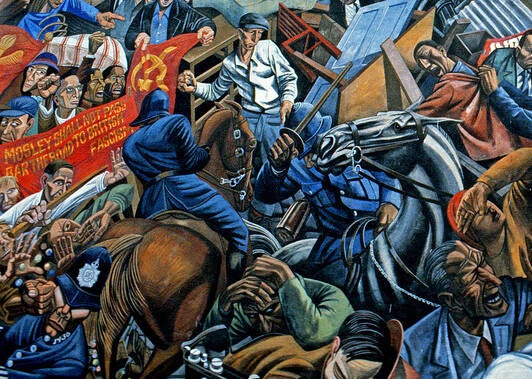
From Eugène Pottier to Leadbelly, from The Clash to Fela Kuti, from Bertolt Brecht to Dario Fo, songs, poems and plays can be part of this living project. They live in the mind and can be transmitted and shared, expressing much more than a single static memorial. They are available to all and proof against any establishment attempt to control them. We can seek out new, progressive books and plays, or re-interpret old ones. The visual arts too can send powerful, irresistible messages. The idiocy and arrogance of politicians are satirised in the work of Gerald Scarfe and Steve Bell. Graphic novels like Art Spiegelman’s Maus and Joe Sacco’s Palestine can tell of the human tragedy of political intolerance and oppression. And painting can also be a dynamic and expressive medium, in which class conflict can be clearly depicted, as in Goya’s El Tres de Mayo, Picasso’s Gernika, the murals of Diego Rivera and - their British equivalent - Dave Binnington and his team’s Cable Street mural.
But ultimately, the testimonies to all these struggles are the achievements themselves. They are not to be ‘memorialised’ in fossil form. They need to be celebrated as living things, constantly in mind, always debated, always defended, always enlarged and extended. We need them for themselves, and also to inspire us in the battles still being fought, from Windrush to Grenfell, from Black Lives Matter, to arms control, to the search for a sane environmental future.
Photo: Section of the Cable Street mural in London's Shoreditch.
Add comment
Comments