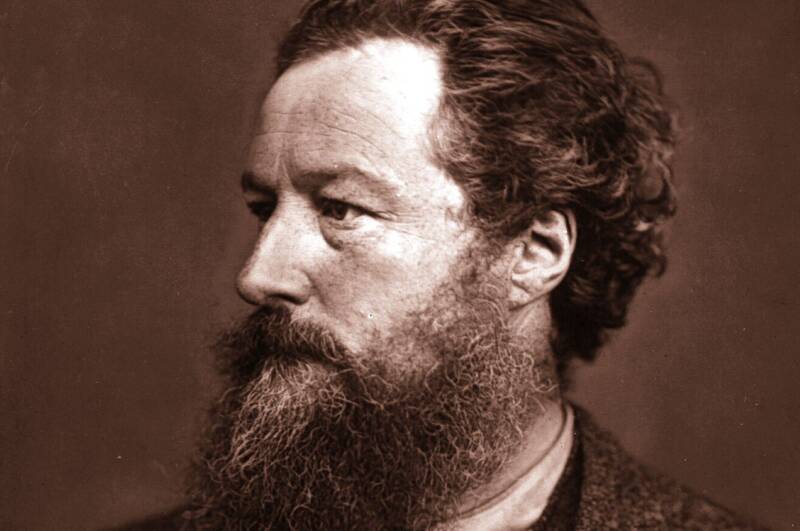
Morris was a poet and designer, but was also political - something we often forget. He said,
I had thought that civilisation meant the attainment of peace, order and freedom, of goodwill between man and man, of the love of truth and the hatred of injustice…a life free from craven fear, but full of incident: that was what I thought it meant, not more stuffed chairs and cushions, and more carpets and gas, and more dainty meat and drink - and therewithal more and sharper differences between class and class.
As we know from Engels, Mayhew, Dickens and many others, the 19thC world that Morris was criticising offered luxury to some, comfort to others, but for many people squalor and deprivation. We may say we have come a long way since then. Health, life expectancy, living conditions - surely they are better now. Isn’t this due to capitalism? If so, what’s the problem?
Let’s look at capitalism in practice. We can take cars as just one example out of many. The automobile was developed by capitalists. It is a very useful thing. Electric cars cause less pollution than petrol driven ones. Surely this is one of many ways in which the capitalist system improves lives. Yes, but it also creates problems, environmental and social.
The fossil economy
Electric cars use electricity, which has to be generated - the UK still uses natural gas to generate electricity - 40% of our total generation. Michael Gove has just given the go-ahead to a new deep coal-mine, and the Prime Minister has issued 100 new licences for oil and gas exploitation. The Drax power station in north Yorkshire uses biofuel. It is claimed as sustainable but is also accused of cutting down old woodland.
Manufacturing the car itself involves embodied energy. Car bodies need aluminium, steel, plastic, glass, rubber and batteries need copper, cobalt, manganese, lithium. Many of these materials are mined at drastic social cost in the global South, often using child labour. To be processed, these materials have to be transported, at great environmental cost, between different parts of the world: cobalt from the DRC and lithium from Chile may go to China fro processing, and to the USA for manufacture. Tesla has factories in both Michigan and California. The manufacturing process itself uses energy, including. lots of water. Making a car uses some 180,000 litres of clean water; 1.2 billion people in the world (according to the World Bank) have no clean water to drink. Then, after its life a car has to be disposed of or recycled. The UK recycles only a small proportion of its waste; most of its battery waste goes to China and its plastic waste to Indonesia - again at great environmental cost.At the moment, transport is responsible for some 23% of the UK’s carbon footprint.
Battery cars are still cars; they still involve road-building, cause traffic congestion, the hollowing-out of city centres, the decline of public transport, and we still need to build for them an extensive national network of charging points.
And in the end, all cars are produced for private profit, not public benefit. We mustn’t forget the insidious part played by the road lobby - the car firms, the motoring organisations, the haulage contractors, the cement and asphalt manufacturers, the fuel manufacturers and others - who exert political influence for the sake of profit.
What sort of world?
Let’s say that most of us (not all) long for a world which:
- provides a decent life for all its people,
- gives special respect to the most needy in society, and
- protects and nurtures the environment.
What I’ve just described, however, is a system which provides great wealth for a very few, tangible benefits to a rather larger number, and gross disadvantages for very many others.
Capitalism actually depends on there being a wide gap between rich and poor, on not giving a decent life to all, on continuous accumulation, exploitation and waste of the world’s resources, and with all that the destruction of the natural environment. It is still Morris’s 19thC world but now on a larger, international scale.
Now there are perhaps three ways of responding to this.
One is simply to ignore the problems, to deny that there is a climate crisis, to insist that capitalism is the best possible system, indeed, the only conceivable system. We are all complicit in this, even if only subconsciously. Mark Fisher (in his book Capitalist Realism) suggests that we now find it easier to conceive of the end of the world than to conceive of the end of capitalism. This is music to the ears of those who wish to go on exploiting the earth’s resources for profit.
A second response is to trust in capitalism itself to solve the problems. This is the view, for example, which dominates the annual COP talks. It is true that there is much creativity in the capitalist world. New technological solutions are being offered all the time. Don’t we have carbon offsetting? Aren’t BP coming up with alternative energy solutions? Surely we can rely on our present system to come up with the answers? But we cannot continue to put forward technological solutions for ourselves in the global North, which do nothing to change the exploitation of the global South, the pillaging of the world’s resources, and relentless climate change.
Thirdly, there is the conviction of William Morris and an increasing number of moderns, from E F Schumacher to Paul Goodman, to Mike Davis, to John Bellamy Foster, to Naomi Klein, to Greta Thunberg, that we need to go beyond capitalism.
The river of fire
Fairly late in life, Morris crossed what he called ‘the river of fire’ that separated his cosy bourgeois world from the mass of humanity. He became a revolutionary socialist, dedicated to bringing capitalism to an end.
In 1883 he read Marx’s Das Kapital - in French. The English version didn’t come out till 1887. He was swept away by the vigour of its historical analysis, though he suffered what he called 'agonies of confusion of the brain over reading the pure economics of that great work'.
First, he joined the new Social Democratic Federation. Then two years later, with Eleanor, Karl Marx’s youngest daughter, and her husband Edward Aveling, he was a founder member of the Socialist League, aiming to take British socialism in a more revolutionary direction.
From then on till his death in 1896, he dedicated his life to the class struggle. He edited the League’s magazine, Commonweal, wrote political articles and pamphlets, gave speeches, took part in direct action in the London streets, and wrote his two revolutionary novels, A Dream of John Ball (1886) and News from Nowhere (1891).
It’s this last 12-year phase of his life which speaks most to us today. News from Nowhere, in particular, is central to the environmental debate, especially in its conviction that a healthy ecology will absolutely depend on social and economic transformation.
Life in Nowhere
You may know the story. A writer falls asleep and wakes in a new socialist world. A revolution has taken place. Society is based on common ownership and, crucially, the democratic control of production. There is no top-down government, no over-riding monetary system, and society has become benign enough to do away with law-courts and prisons. The Houses of Parliament - reflecting Morris’s dim view of politicians - have become a storage place for farmyard manure.
Individuals can develop as people because society values everyone equally. This utopia, this ‘nowhere’, is a place of classlessness, gender equality and sexual freedom. Life is lived in harmony with nature, and work has become creative, with machines freeing people from drudgery, rather than imposing it on them, as capitalism does. And those doing the most menial tasks of all are valued highest of all.
It is a glowing, poetic, open-ended vision. What it is not, however, is a prescriptive blueprint for the future. E P Thompson suggests News from Nowhere is essentially: 'a revelation of the powers slumbering within men and women'.
That’s you and me. We can change the world. Morris recognised that fundamental change, a ‘change is the basis of society’, would be a long-drawn-out process. In A Dream of John Ball, the dreamer says this about the priestly revolutionary, John Ball:
Men fight, and they lose the battle, and the thing that they fought for comes about in spite of their defeat.
Radical change
In other words, we must expect set-backs. To win in the end we must be persistent. In News from Nowhere, Morris’s fictional world comes about as the result of revolution. We may be reluctant to use this word, but we do need an equally radical change. Radical change now is better than allowing the present chaos to get even worse. To quote Morris again:
The word Revolution, which we Socialists are so often forced to use, has a terrible sound in most people's ears, even when we have explained to them that it does not necessarily mean a change accompanied by riot and all kinds of violence, and cannot mean a change made mechanically and in the teeth of opinion by a group of men who have somehow managed to seize on the executive power for the moment…people are scared at the idea of such a vast change, and beg that you will speak of reform and not revolution…
…however, we Socialists…will stick to our word, which means a change of the basis of society; it may frighten people, but it will at least warn them that there is something to be frightened about, which will be no less dangerous for being ignored; and also it may encourage some people, and will mean to them at least not a fear, but a hope.
In other words, Morris says, we need to fight for ambitious, radical, systemic change because, if we don’t, a different kind of change will come about, which will be much more destructive, even than revolution. Morris’s last words, reputedly, were:
I want to get mumbo-jumbo out of the world.
Add comment
Comments