Most people, I’d like to think, want a world which offers a decent life to everybody, which gives special respect to the most needy in society, and in which the natural environment is preserved and nurtured. I say ‘most’ because there are many who clearly don’t want this and who work hard to negate it. At this particular stage in history, it is this latter group whose power dominates the world and the way it works.
If we are to salvage a better world out of the growing social and economic wreckage, there are three key things I think we need to challenge: the exploitation of one class by another, which forms the basis of our present economic system; the supportive ideology which ensures the hegemony of the privileged class; and the process of unrestrained accumulation by which this same class depletes and destroys the resources of the world.
These three things, of course, are three fundamental elements of capitalism. It is our economic and political system which needs to be fundamentally changed. But this is not to be said lightly. In the first place we need to believe it. Francis Fukuyama (1) posited that the triumph of capitalism represented the ‘end of history’ and Mark Fisher (2), in his book Capitalist Realism, suggested that we now find it easier to conceive of the end of the world than to conceive of the end of capitalism. Subconsciously, we may share this view, so the first, fundamental question is whether we believe such a change is even possible. But if we don’t believe in change and work for it, the strong likelihood is that we can only enter an age of barbarism and chaos.
The question of agency
Assuming we do want to confront the problems, we are left with the fundamental question of agency. If we are to attempt to change, who or what can make the change come about? It is clearly not to be expected from those for whom capitalism already works very nicely: the business interests, the bourgeois political structures, all their supportive legal systems, their forces of repression and their commentariat of apologists. Their involvement in environmentalism is no more than a cover for continued exploitation. Electric cars, to take just one example, improve things for the global North - while no doubt making some people extremely rich - but still depend on oppression of the mining communities of the global South.
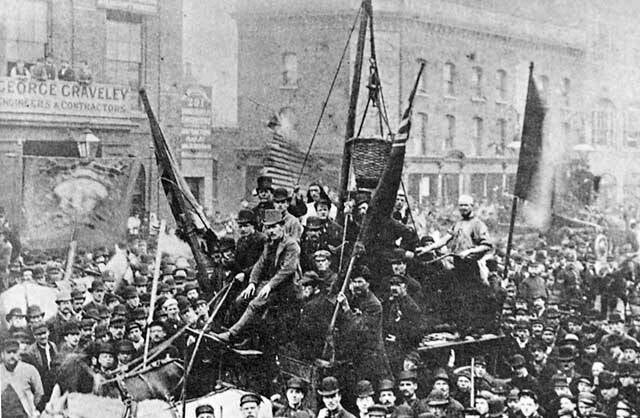
Marx and Engels, back in 1848 when they wrote the Communist Manifesto, offered an unparalleled analysis of capitalism, together with a vision of a better world and the means of getting there. For them, the progressive agency was to be the urban proletariat, the industrial working class whose key role in the production process gave them a huge potential strength. In the potential and actual revolutions in Europe between 1848 and 1917, the workers played a crucial role. The world is still predominantly industrial, and working class power still exists, but it’s undeniable that some things have changed since Marx’s time.
Most of the political Left still value the idea of the industrial working class as the engine of change but now see it as part of a much wider constituency, involving minority groups and communities worldwide, including those rural and indigenous peoples who are suffering most from economic exploitation and the ensuing environmental crisis. But in trying to redefine the nature of the revolutionary class there are big issues to be considered.
The geographical centre of gravity of the working class has shifted, from the European arena with which Marx and Engels were familiar, mainly to China and the east Asian seaboard. This does not mean there is less potential for working class organisation and militancy, but we have to understand the different context, and respect the aspirations of different groups of workers, in different cultures - work alongside them, in fact.
Marx and Engels were fully aware of the alienating effects of machine production, but could not fully anticipate how far industrial employment levels would be affected by the use of robotics, still less the development of Artificial Intelligence. As robotics developed, and western society became ‘post-industrial’, André Gorz (3) anticipated no less than the end of the working class. It is true that industrial employment in the West has diminished, thereby reducing its potential for collective action by the proletariat.
On the other hand, the industrial labour force worldwide has tended to increase in number, albeit shifting the geographical focus of potential resistance. It has also become clear that many white collar jobs have themselves been proletarianised; unmet social needs have spread across a wider spectrum of world society. In these respects, the potentially revolutionary agency has grown rather than diminished.
Outside the system
Then there is the very large number of workers who now exist outside the capitalist system altogether. These include not only various indigenous pre-capitalist societies, but also those fringe urban societies living on the detritus of the capitalist world, the dispossessed, the refugees and all the unemployed whom capitalism has rejected. Their worldwide number of two billion is steadily growing. Yet these are the very people who suffer worst from the social and environmental effects of capitalism. How such people begin to express their needs and exert their potential power for change is a key question. Independence from the capitalist system offers a different kind of scope for resistance.
Urbanisation continues. Cities now contain over half the world’s population and the proportion is steadily growing. If working class organisation at industry level is under pressure, the possibility of organising as whole communities or cities or societies is growing all the time. The city has long been the focus of legitimate political demands, and of the action taken to achieve them, and this is likely to strengthen. Information technology and social media have become a significant factor in organising political protest. The bourgeoisie may be able to destroy this or that industry - and do so all the time - but a whole city or a whole class might be a more robust focus of resistance.
Working hard to create all these connections will be an important way of challenging the hegemony of the world’s fossil culture. Provided it is based on a clear-sighted recognition of what the problems are, this could be effective at any and all levels, local, regional and international. It is possible to start local and grow. Rosa Luxemburg, after all, simply suggested that ‘the most revolutionary thing one can do is always to proclaim loudly what is happening’.
1. Francis Fukuyama, The End of History and the Last Man, revised edn., Penguin 2020
2. Mark Fisher, Capitalist Realism, new edn., Zero Books, 2022
3. André Gorz, Farewell to the Working Class; an essay on Postindustrial Socialism, Pluto Classica, 1997
Photo: The great Dock Strike, 1889
Add comment
Comments