I wrote this originally in November 2024, but with one or two updates it still seems relevant.
On 11th September 2001 I was teaching at a university in London. During the afternoon the Dean’s PA told me the news, that the World Trade Centre in New York had been attacked and destroyed. I was due the next day to take a seminar with my group of American city planning students, many of them from New York. What possible response could I make?
I couldn’t possibly stick to the scheduled subject, so we just talked. It was clearly difficult even to contextualise the event, to talk about cities as places of political violence, or to talk of other urban atrocities - Coventry, Dresden, Hiroshima. The question that came up time and again was ‘why us?’ Things like this happened in Europe or Asia, but not in the USA.
There was genuine distress and vulnerability in the air, and it would have been difficult, and inappropriate, to remind ourselves of all those instances in which the USA had felt quite entitled to attack or dominate other weaker nations, and to the inevitable resentments that followed.
Too much to bear
I am reminded of this when thinking of the attack by Hamas on the people of south Israel, on 7th October 2023. In the immediate aftermath there seemed to be a widespread view in Israel that things were proceeding quite normally when suddenly the Hamas attack came out of nowhere. Israel, the dominant force in the Middle East, was caught off guard. This was too much to bear. As in New York in 2001, people were too shocked to want to contextualise the event.
If, as is claimed, the atrocities started with Hamas, coming out of the blue, then the peace-loving Israel is only ‘defending itself’ from those who want to obliterate it. A massive military response is needed to ‘get rid of Hamas’. If at the same time Palestinian civilians are killed, that’s too bad; they probably deserve it anyway.
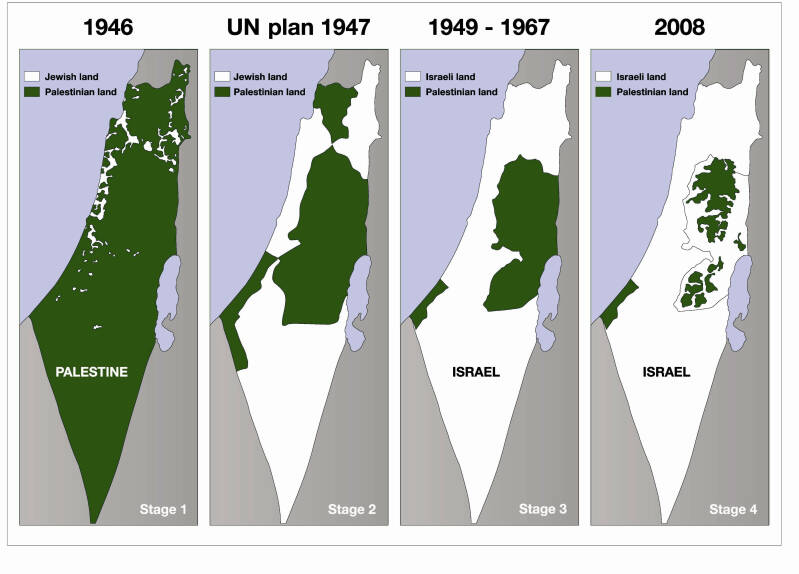
But of course the attack didn’t come from nowhere; it came from 75 years of oppression during which Palestinians have suffered huge losses. There was the Nakba itself - the ‘catastrophe’ - and the massacres at Deir Yassin and later at Sabra and Shatila, the two Intifadas, the attacks on Gaza in 2008 and 2014, and on the Great March of Return in 2018. Tens of thousands of Palestinians have been killed. and millions have become refugees.
As a counterpoint there has been the steady drip-feed of casual killings in the West Bank which have generally gone unreported and unpunished. And then there are hundreds of thousands of people wounded by live weapons, and hundreds of thousands displaced from their homes and land. This is a process that can only be called ethnic cleansing, and the appalling events in Gaza in the last two years surely amount to genocide, or the term has no meaning.
Ethnic cleansing
But it is not widely recognised that ethnic cleansing and, if necessary, genocide have been Israel’s aim from the beginning. This was understood by Hertzl in the late 19th century and implemented soon after by Jabotinsky. In 1948 David Ben-Gurion set the tone for the future of the new Israeli occupation of Palestine. The aim was ‘as much land as possible with as few Palestinians as possible’. This attitude has defined Israeli policy ever since, right down to Netanyahu, Ben-Gvir and Smotrich, who have become ever more aggressive. When Israeli politicians can call Palestinians ‘human animals’, their readiness simply to get rid of them could hardly be clearer. In November 2024, Israeli government minister Avi Dichter was quoted as saying, with a certain pride, ’We are now rolling out the Gaza Nakba’.
One grieves with ordinary Israelis for their pain and loss. But insofar as the Hamas attack is seen as unexpected or inexplicable, it seems clear that the narrative offered by the Israeli government, their press and their education system, creates either ignorance or indifference to the facts of history. It is only by admitting the truth of what has been happening for 77 years that any kind of rapprochement can come. To recognise Israel’s colonial oppression is not to ‘support Hamas’ nor to condone Hamas’s attack in any way. But one does need to understand - and change - the material conditions which gave rise to it.
Maps: The shrinking Palestine
Add comment
Comments