God gave Noah the rainbow sign
No more water, the fire next time…
(from a Spiritual quoted by James Baldwin for the title of his best-known book)
Disastrous
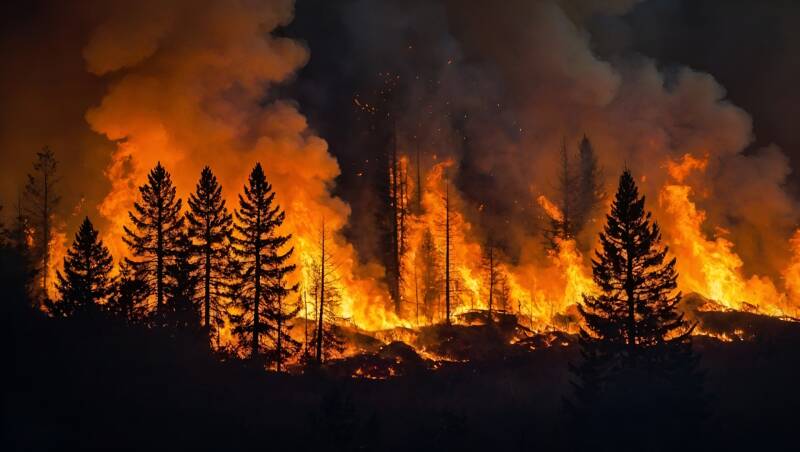
As the landscape burns, three huge, interlinked problems loom over the world we live in:
- its unfair wealth distribution, whereby some people are grossly enriched and many others condemned to lives of poverty and deprivation
- its heavy reliance on costly, destructive and murderous warfare as an economic necessity, and
- its profligate over-use of natural resources leading to destruction of the environment.
Combined, these three disastrous scenarios are creating a deep human crisis, and point to a future of chaos, conflict, destruction and extinction. Some geologists have referred to the Anthropocene, a supposed epoch in which the actions of humankind have begun drastically to affect the geology and climate of the planet. It would be ironic indeed if the only planet known to be suitable for life were to be destroyed by its dominant and supposedly most intelligent species.
Human nature?
But is ‘the human race’ actually the problem? Is humankind by nature inevitably acquisitive, rapacious and destructive? Some may say ‘yes’, arguing that ‘human nature’ leads us to act in this regrettable way. Yet it is obvious we can and do act humanely and co-operatively, that we form families, groups and communities, offer mutual support, value creativity, affection and love. Indeed, if we didn’t, the human race would not have survived till now. To believe in the future we need to believe in the sheer humanity of the human race. I am sure most people of the world do aspire to a better life for all, and look for ways of achieving it. But there is a key alienating factor which holds us back.
In his seminal essay on the Eighteenth Brumaire, Marx points to a crucial limit to people’s actions:
Men make their own history, but they do not make it as they please; they do not make it under self-selected circumstances, but under circumstances existing already, given and transmitted from the past.
Beneficiaries
It is not ‘human nature’ which binds us, but the historic class structure of our society. From it has emerged the capitalist system, which has grown over many centuries into a complex integument limiting everybody's thoughts and actions. We can clearly blame greedy capitalists, some of whose personal fortunes exceed the GDPs of most of the countries of the world, or devious, unprincipled politicians seeking personal power. But many others of us are implicated: the large numbers of people throughout the world who, as producers, consumers or beneficiaries of the capitalist system are reluctant to reject it, despite recognising its malevolent effects on the world’s poor, the common good and our global environment. The task of dismantling it seems too huge and - we like to convince ourselves - unnecessary.
Mark Fisher, in his book Capitalist Realism (2022), has said that many people would sooner see the end of the world than the end of capitalism. Jonathan Cook, in a recent Substack article, says the West is dying but that ‘we still can’t imagine life without capitalism’. The Global North knows that it is destroying the world but cannot bring itself to combat its own forces of destruction.
Reminder
Let’s remind ourselves what Capitalism is. I say ‘remind’ because the nature of industrial Capitalism has been an essential part of human knowledge at least since the late 18th century. While recognising that it has had some spectacular achievements (as indeed Marx and Engels do), we must also recognise it as the overwhelming power through which the world and its people are threatened.
Capitalism is a system of commodity production for profit. Though they often claim to do so, capitalists are not there to bring benefits to all; they depend absolutely on the exclusivity of wealth, with just enough largesse to keep the system working. They value people only as workers, consumers and acquiescent voters, and disregard the needs of the billions of people who fall outside their system.
Nor is capitalism there to create a stable society; it depends absolutely on competition and conflict, not only between capitalists and workers, but also between rival capitalists and the political machines they are part of. Being anarchic itself, capitalism promotes anarchy. And ultimately, conflict demands those most expensive and profitable commodities of all, namely armaments and surveillance systems which, to be justified, have to be used in war.
Nor is capitalism there to benefit the earth and its living organisms; instead, the earth is there to be pillaged of its resources, without control and without limit. Human life and culture, animal species, eco-systems, the oceans, the landscapes, the air, the climate itself, are seen as exploitable and expendable.
Our economic system has not just caused these problems; it demands them. It cannot be relied on to solve them. If the world and its inhabitants are to avoid a social, political and environmental melt-down, there has to be a revolutionary change. The question is, what is it and how might it come about?
Photo: Forest wildfire (Public Domain Pictures)
Add comment
Comments