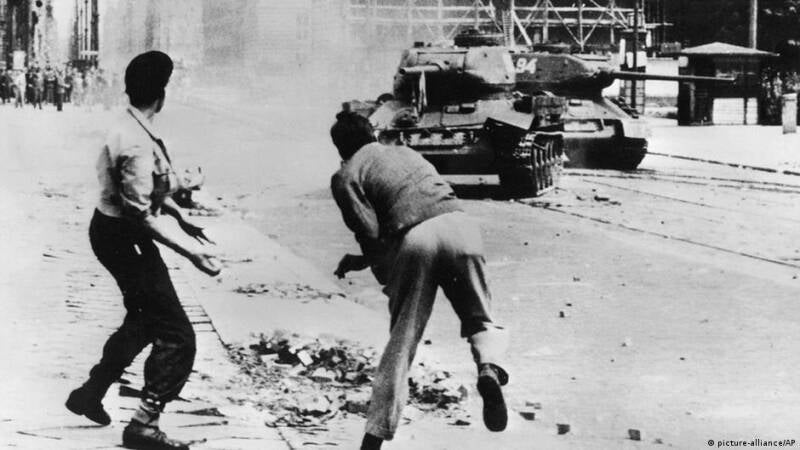
Here is Die Lösung, the famous little poem by Bertolt Brecht about the East German workers’ revolt in 1953.
After the uprising of 17th June
The Secretary of the Writers’ Union
Had leaflets distributed in the Stalinallee
Stating that the people
Had forfeited the confidence of the government
And could win it back only
By redoubled efforts. Would it not be easier
In that case for the government
To dissolve the people
And elect another?
The uprising against the repressive Communist government involved more than a million workers and was only put down through the intervention of Soviet tanks. Brecht’s ironic title, ‘the Solution’, reflects the smug unassailability of the regime - whatever was wrong was not going to be their fault but other people’s. Blaming things on the people is an increasingly common ruling-class tactic, though it is not new. It’s part of the manipulative process through which rulers maintain their position. Plato in ‘The Republic’ argued that Athenian democracy was prone to manipulation by demagogues. Antonio Gramsci, writing in his prison notebooks, described how, in a parliamentary democracy, the state maintains
a combination of force and consensus which vary in their balance with each other, without force exceeding consensus too much. Thus it tries to achieve that force should appear to be supported by the agreement of the majority, expressed by the so-called organs of public opinion - newspapers and associations.
Disarming criticism
One way the state has of disarming criticism is to create a false sense of community, of which both it and the people are part. We see this most clearly in cultural traditionalism: the celebration of patriotic events, ranging from past military victories to sporting achievements and royal anniversaries, which create a sense of supposed community and national exceptionalism. One variant of this is the state’s response to crisis, economic or social: ‘we’re all in this together’. This was said both of the global financial crash of 2008 and of this year’s Covid-19 emergency. It is patently untrue; in both cases we have seen that misfortune, like wealth, is unevenly distributed, to the disadvantage of the poor. Nevertheless, a lot of effort goes into persuading us that while it is acceptable for us to set nations and races against each other, that there’s no such thing as class; we’re all in this together.
Politicians have also become very good at avoiding blame. It is, of course, a very human wish to be thought well of, but this goes further. Politicians hope to achieve electability and, increasingly, to avoid legal challenge. With accusations of war criminality attaching, say, to the invasion of Iraq, it is understandable that those who ordered it should continue to insist upon its legality and rightness. So it has become commonplace for politicians, like the character in the movie ‘Love Story’, never to have to say ‘sorry’. They have become expert at the ‘non-apology apology’. They may express ‘regret’ but without admitting any responsibility. They may regret, for example, that ‘someone might have been offended’, thereby placing the blame on the sensibilities of the listener or onlooker, rather than themselves. They may often generalise the offence, regretting that ‘mistakes were made’, without attributing or accepting liability for those mistakes.
The blame game
On the other hand, if an attribution can offer political advantage, there will be no hesitation in blaming civil servants, local authorities, the previous government or other governments. In the end, there is always the option of diversion by deferral, of saying something like: ‘We take people’s health and safety very seriously; we will look carefully into the matter and learn from it what lessons we can, to make sure something like this does not happen again’. A blog from the liberal-capitalist Institute of Economic Affairs in April strove to exonerate the government from its incompetence in dealing with Covid-19, blaming instead the financially starved hospital trusts. More and more - to go back to Die Lösung - others are to be blamed.
During the Covid emergency, the government’s narrative has changed. The infection and fatality figures, once prominent in daily briefings, are being played down. The lack of PPE, the lack of testing, the long-drawn-out search for a vaccine, are taking second place to the narrative about lifting the lockdown, re-opening schools, getting back to work and saving the capitalist system, as if the virus was being defeated. The government instruction, peremptory but vague, of Stay alert/Control the virus/Save lives tries to put the onus for achieving this on the public. The public of course wants to get back to work, and wants its children to be schooled. But I doubt if it wants dangerous, precipitate decisions to be made. The health experts advising of the dangers, the parents and teaching unions fearful for the children’s safety, do not need to be told that what they want is at odds with the capitalist economy, that they will be fined if they don’t co-operate. The public deserves both the protection of their health and a sane well-ordered economy within which to work. Any government has a duty to achieve both of these, not to play one off against the other. If our economic system is incompatible with the people’s health, it is the system that must be changed, not the people.
But the government manipulates and prevaricates its way towards reconstituting the same bad old economy, for the sake of its coterie of supporters, the very economy which caused the problems in the first place. Instead of this dire approach we need one which really does learn lessons. Creating a healthy, well-ordered society of living, work and leisure, within an economy which addresses inequality and protects the environment is not impossible and indeed could be very achievable, but it seems to be too imaginative for our present regime to conceive. If blame attaches to us at all it is because we still put up with them.
Add comment
Comments