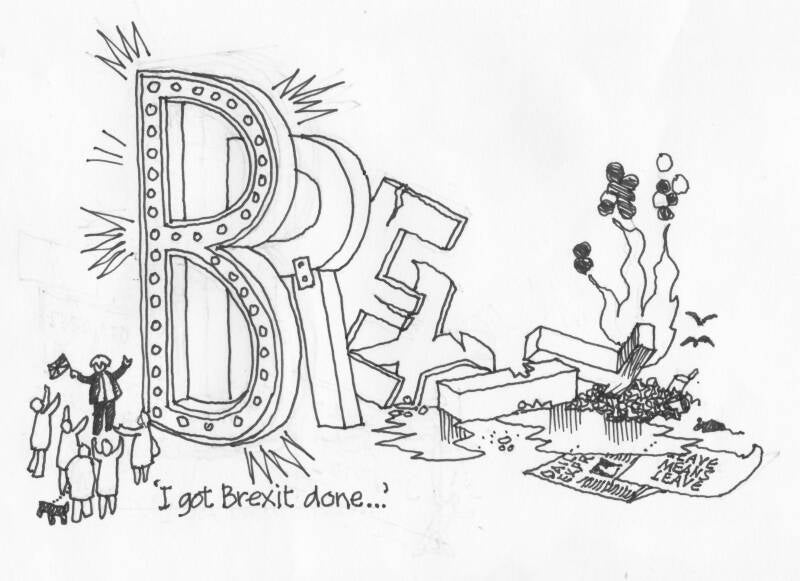
On 20 July 2022, Boris Johnson attended the House of Commons, marking, it seemed, the end of his Parliamentary duties and responsibilities - though he did, at the expense of the taxpayer, keep on at his country house for several more weeks. Parliament did not need to give him a fulsome farewell - he was quite happy to do that for himself. He praised himself on three counts, the three which have become his purported justification over the last few weeks.
Firstly, it appeared, he ‘got Brexit done’. Well, not exactly - in fact, we were just at the beginning. Seventy or so ‘trade deals’ had been done, but most of these were roll-overs, simply holding the line on pre-Brexit arrangements. Trade with the EU, Britain’s biggest market, fell away and become more difficult. Trade with Ireland, badly thought-through before Brexit, remained an insoluble problem, threatening the Northern Ireland peace process. The reduced movement of labour between Britain and the EU created employment and production problems in Britain. Some British companies folded, or moved their businesses abroad. British farming and fishing were badly hit. There continued to be chaos at the borders, both for businesses and ordinary travellers, and the chief inspector of borders and immigration described arrangements for migrants as unacceptable. And the increased costs and bureaucracy exacerbated Britain’s severe cost of living crisis.
Johnson’s second achievement? ‘We’ve helped, I’ve helped, to get this country through a pandemic’. The success of the vaccine roll-out is what he referred to. But people might also remember the government’s inertia when given a clear warning that a pandemic was on its way. Also its reluctance to act once Covid arrived, and its initial policy of allowing the pandemic to ‘run through’ the population to achieve a so-called ‘herd immunity’. Then there was the chaos of a ‘world-leading’ test-and-trace system run by incompetent contractors appointed secretly by the government. Then the decanting of elderly patients from over-stressed hospitals into equally over-stressed and under-resourced care homes. Then the indecent haste of ‘opening-up’ Britain for business with the pandemic still rife. The net result was around 200,000 deaths, at a continuing rate of some 500 a week.
War rhetoric
The third, and perhaps most specious claim of all, was that ‘(I’ve) helped save another country from barbarism’. Ukraine, of course, is not yet ‘saved’ from the barbarism of Putin’s invasion. If it is to be, then at some stage, a cease-fire and serious negotiations will have to take place. It is questionable if this aim is served by western intervention, war-like rhetoric and military assistance, though Johnson and his current Foreign Secretary and Defence Secretary seemed determined to pursue this line. It has to be asked if theirs was really an attempt to end a conflict, or whether it had some other, perhaps electoral, significance. And after all it is easy enough to talk up war when others are doing the suffering and the dying.
Citing his three ‘achievements’, Johnson said, ‘and frankly, that’s enough to be going on with. Mission largely accomplished’. This, of course, depends on what you consider your mission to have been. If Johnson’s mission was ‘accomplished’ it clearly hadn’t included (despite all the rhetoric about ‘levelling-up’) addressing the widening gap between rich and poor in the country, nor the rampant inflation, nor the worsening cost of living crisis. It hadn’t included facing up to the problem of the declining public sector, the crisis in the NHS and other public services. Nor had it included a serious attempt to address the environmental crisis, so tellingly demonstrated by the recurrent ‘heat apocalypse’. In the end, perhaps he was right to say ‘that’s enough to be going on with’. We had had enough, and ‘leave’ meant ‘leave’.
Add comment
Comments