Whenever there is a grand, patriotic occasion, we can always find some theatrical knight of the realm ready, with thrilling voice, to recite John of Gaunt’s speech about England, from Shakespeare’s Richard II. You know the one:
This royal throne of kings, this sceptred isle
This earth of majesty, this seat of Mars,
This other Eden, demi-paradise,
This fortress built by nature for herself
Against infection and the hand of war….
It is chosen and delivered in order to create a mood of patriotic exceptionalism, and can be relied on to do so. The British establishment, like all ruling classes, knows how to appropriate culture for its own purposes.
What is always left out, on such occasions, is the next bit of the speech, in which Gaunt laments the corruption and decay to which bad government has brought this lovely land, ‘now bound in with shame’. This, some might think, would be a more appropriate comment on Britain today than a bit of purple patriotism. It is clear why this is done, of course, but it is always specious to take chunks of Shakespeare out of context.
Last night
I am reminded of this every time the last night of the Proms comes round, with its own examples of cultural appropriation. Another diet of unabashed chauvinism is offered, with 'Pomp and Circumstance', the sea songs, 'Rule Britannia' and the national anthem. William Blake, however, is perhaps the main fall-guy. This great, revolutionary artist and poet wrote some now-famous lines which appear in his epic, Milton; a Poem. Taken from their context and set to music, they became a song known by the name of ‘Blake’s Jerusalem’.
Parry’s tune is splendid, and Elgar’s orchestration is magnificent. Between them they have created a song sometimes claimed as a ‘second national anthem’. It is expected to be sung with patriotic fervour on national occasions, royal, political, religious or sporting - sung, let it be said, without too much attention to what the words mean. Simply to sing it in this way is to create a warm feeling of nationalism, which accepts our unequal world as inevitable.
It is true, of course, that Blake loved his country of England - Albion, as he called it - but Blake’s Albion is not the tight, officious, exploitative England preferred by the ruling classes, either of his day or ours. Blake’s Albion was a metaphor for the whole of creation, for the brotherhood and sisterhood of humankind, and for the recognition of all people as essentially divine. The 'Jerusalem' he strove for was not a place, or a political system, but a heightened state of moral being. He railed against injustice, he sympathised with the poor, he pitied the plight of orphaned children and the exploited young chimney sweepers and child prostitutes, he abhorred the exploitation of slaves and he despised those who would destroy the natural world.
To see a World in a Grain of Sand
and a Heaven in a Wild Flower,
hold Infinity in the palm of your hand
and Eternity in an hour.
Where is your Brexit in that? Or your herd immunity, or your ’stop the boats’, or your ‘hostile environment’, or your undermining of net zero?
Dark, Satanic
Blake’s enemies were the Monarchy, the Tory government, the established Church, the right-wing press and the exploiting industrialists of his age and, by extension, of ours. The ‘dark, Satanic mills’ of his poem were not physical factories but the elitist universities, mechanically grinding out ready-made, conventional wisdom.
Rejecting these meant we had to fight. Hence his bow of burning gold. Blake saw the world in dialectical terms, that is, in terms of what he called Contraries. He described these in The Marriage of Heaven and Hell:
Without Contraries is no progression. Attraction and Repulsion, Reason and Energy, Love and Hate, are necessary to Human existence...Good is the passive that obeys Reason. Evil is the active springing from Energy.
The idea of Good being retrogressive and Evil being a positive is frightening. Blake's quest for Jerusalem was not based on acquiescence and acceptance of any kind of status quo. It was to harness both the Reason of Goodness and the Energy of Evil to bring about a richer, transcendent sphere of existence. The establishment has much to fear from him. T S Eliot called him 'terrifying'.
By all means let us sing his song. With Parry and Elgar’s help he has given us something joyful to sing. But let’s sing it with his meaning. Let’s refuse to allow Blake’s enemies to hi-jack his poem and to use it against him and against the world.
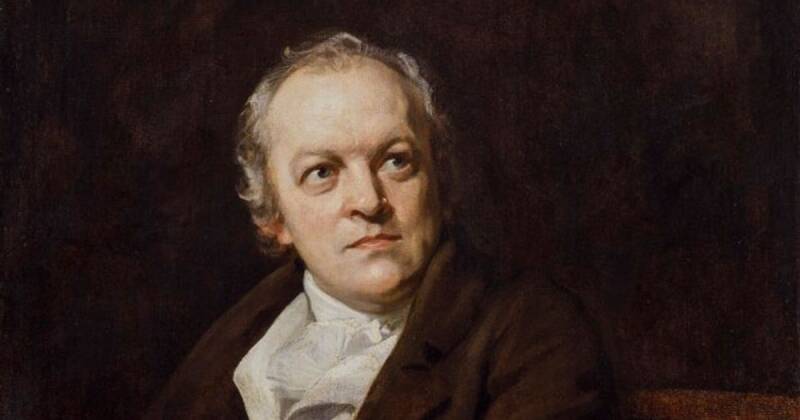
Picture: William Blake, by Thomas Phillips (1807)
Add comment
Comments