I began writing this on 27th January 2024 - the annual international Holocaust Remembrance Day which commemorates the Red Army’s liberation of Auschwitz in 1945. In WW2, the most terrible episode of the 20th century, millions were killed, not only in combat, as fighters or as supposedly unavoidable ‘collateral damage’, but more significantly in deliberate acts of mass killing, including the carpet bombing of large urban areas and terrible programmes of extermination.
The exact figures are a matter of debate, but in the Holocaust itself the mass killings may have included six million Jews of different nationalities, 4.5 million Russian prisoners of war, 1.8 million non-Jewish Poles, over 200,000 Roma and 200,000 chronically disabled German citizens, as well as Communists, dissenting intellectuals and gays, all in the aid of ‘purifying’ the Aryan race. Holocaust Remembrance Day was originally devoted to the Jewish victims, but is now supposed - though with significant reservations - to remember all victims of genocide. Its mantra of ‘Never Forget. Never Again’ does not mean much unless it applies to everyone.
Never forget?
In Auschwitz-Birkenau alone, over a million people died, mostly Jewish, 18,000 children among them. Today, 27th January 2024, politicians lit candles and repeated ‘Never Forget. Never Again’. Yet at the same time, Yemen was being bombed and in Gaza, an even bigger prison than Auschwitz, the erasure of another two million people continued without pause.
After 1945, as we know only too well, wars did not cease. Since then there have been some 300 international military actions fought, many of them full-scale wars. There have also been numerous genocides. We might define wars as engagements in which two military powers are pitted against each other, in which civilians may also suffer as the result of so-called collateral damage. Genocide, however, implies a repressive military power deliberately targeting a virtually defenceless civilian population, with the intent of exterminating it, its identity and its culture.
International order ignored
A raft of international agreements after 1945 had sought to prevent such things happening again. The Genocide Convention of 1948 defined the crime, and the International Court of Justice (ICJ) was created to investigate it. A distinction was drawn between genocide and war crime. In the latter case, individuals as well as groups could be prosecuted. Oversight for this was given to the International Criminal Court (ICC). On the whole, war crimes are easier for the courts to prove than genocide, since proof of the latter depends on evidence of intent.
Since 1945 we have seen genocides in Zanzibar, Bangladesh, Uganda, East Timor, Cambodia, Bosnia, Rwanda, Darfur, Rohingya, Yemen, and many other places, with the loss of millions of civilian lives. Some of these atrocities, mostly those perpetrated by and in the global South, have been prosecuted. As I write, the ICJ has made an interim judgement on Israel for its destruction of Gaza, in a case brought by the Republic of South Africa. Both countries are signatories to the Genocide Convention. The court has ordered Israel to take a number of measures to avoid the killing of innocent civilians, though not to stop its military action. A final decision on whether genocide has been committed lies some way in the future.
Unsurprisingly, Israel’s leading politicians have scorned the judgement. All along, Israel’s well-organised hasbara has maintained that the regime is justified in all it does, that it acts only in ‘self-defence’ and always within international law. In the case of Gaza, it insists that it already does all it can to protect civilians, that they have enough food and water, that they are offered safe zones and safe routes to them, and that they are always warned when airstrikes are imminent.
Accident or design
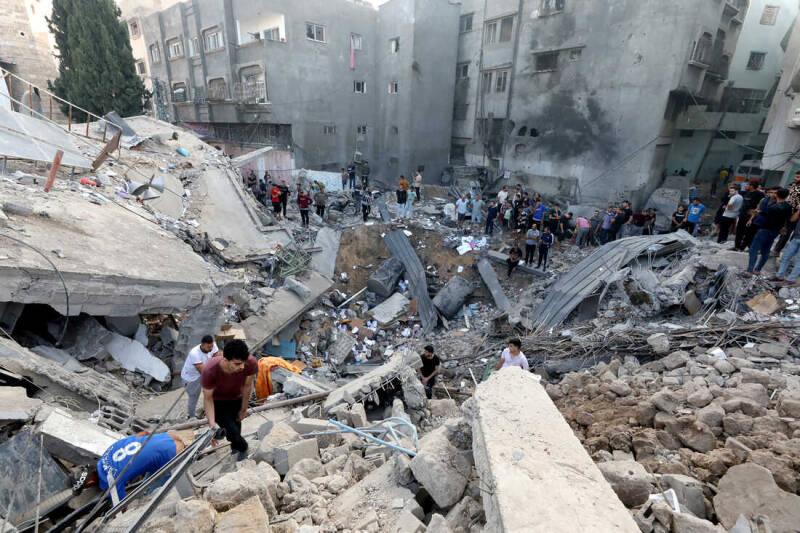
Much of this, however, can be challenged. The almost complete devastation of a community of over 2 million people and the deaths of over 100,000 of them do not happen by accident, and cannot possibly be explained as collateral damage. As has been well documented, the process has included dropping high explosive bombs into residential areas, cutting off water and electricity, denying food aid, the designation of ‘safe zones’ and ‘safe routes’ which are then attacked, the destruction of hospitals known to contain immobile patients, firing on ambulances, the targeting of key institutions - schools, universities, government buildings, museums, mosques and churches, power houses, radio stations, sewage plants and agricultural land - and of key individuals - not only politicians and commanders but also writers, poets, artists and journalists.
The aim seems to be the erasure not only of a people but also of its entire culture. There may not be a written policy document which can be referred to in court, but the very fact of this happening in such a way and on such a scale would seem to be a clear indication of intent.
The enablers
One of the most troubling things about the situation is the inability or unwillingness of the ‘international community’ to take immediate action to put a stop to the carnage. The international legal process is limited in its powers, naturally enough in that these are conferred by a system dominated by supremacist nations such as the USA and the great powers. For a very long time, Israel’s many transgressions of international law have been ignored.
The United States no doubt has strategic reasons for keeping Israel as a western bridgehead in the Middle East - near the sources of oil, as a counterbalance to supposed enemies such as Iran, and as a buffer against the potential influence of Russia or China, and also political reasons such as the administration’s excessive respect for the powerful Zionist lobby - Jewish and Christian - in American society. Hence the unlimited supply of arms, worth some $3.6 billion a year, with a further one-off gift of $18 billion to pursue the current vendetta against Palestine.
Britain’s infamous role
Britain, to its discredit, merely mimics the American and Israeli line, mounting its own propaganda campaign against advocates for Palestine, passing discriminatory laws and, under the Tories, even going so far as to withdraw funding from UNRWA, on which the beleaguered Palestinians absolutely rely, merely because of unproven accusations by the Israeli hasbara machine.
Powerful political regimes have seldom if ever put humanity before realpolitik. Historically, both Britain and the USA have themselves been responsible for genocides in the aid of political control. Israel, a similar settler-colonial regime, does the same. Recently, British or American Jews and Israeli spokespeople have spoken of the importance of ‘defending’ Israel as a refuge for Jews in a hostile world. This is a supreme irony. The violent and intransigeant approach of the Israeli political class has succeeded in making Israel one of the most perilous places on earth, a danger to itself and the whole Middle East region. In October 2024, Israel’s aggression spread into Syria, Yemen, Iraq and Lebanon. It reminds us that for David Ben-Gurion biblical Israel should stretch from the Mediterranean not just to the Jordan but to the Euphrates.
The background
This quasi-religious aim appeals to today's Zionist zealots, and provides an ideological support for expansion. However, the main reason is much more mundane - that of regional hegemony for the USA and its obedient followers. American political and economical control of this strategic, oil-rich region depends absolutely on the destruction of all local communities who might have a desire for freedom, democracy and self-determination. Afghanistan, Iraq and Libya have already suffered hugely and the process continues relentlessly in Palestine.
Picture: Rescuers in the ruins of the 5th century Orthodox church of St Porphyrios, Gaza City - Dawood Nemer/AFP via Getty Images
Add comment
Comments