When Heminges and Condell published Shakespeare’s First Folio in 1623, they classified King Lear as a tragedy and The Merchant of Venice as a comedy. The first is self-evident. Mental and physical abuse abound in King Lear, bringing chaos, injury and death. The Merchant of Venice, on the other hand, ends on an up-beat. A happy resolution is expressed in romantic poetry. And no-one actually dies.
Yet at the same time, The Merchant of Venice leaves very uneasy feelings, which force us to reconsider how happy that happy ending really is. In fact, we need to recognise that Shakespeare, though often joyously celebrating the human spirit, nevertheless saw his world as a tragic one.
Lear’s new world
In Tudor times the traditional feudal way of life, which had dominated Europe since the early Middle Ages, was being directly challenged by the emerging forces of capitalism. All round him, Shakespeare, the acute observer of society, could see the political and economic power shifting and the social conflicts that resulted. It is no wonder that this theme occurs so often in his plays. Measure for Measure deals with state corruption, Timon of Athens with the malevolent influence of money, and so on.
In King Lear, the hereditary, absolute monarch, for reasons of his own, decides to pass his kingdom over to his offspring. But instead of a traditional feudal arrangement, such as primogeniture, he favours a kind of competition among his three daughters. Cordelia, respecting the old feudal norms, is rejected. Goneril and Regan, taking advantage of the new, competitive situation in which they find themselves, are rewarded.
The problem for Lear is that once the feudal bonds and obligations have been set aside there are no more rules. He no longer has status, so immediately becomes a victim of the competitive, acquisitive society he himself has created. So do several others, including Gloucester and Cordelia herself. Shakespeare sees Lear’s newly-created capitalist society as one of cruelty and alienation.
The rise of the merchant
And what of the The Merchant of Venice? Very similar forces are at work. The newly emerging capitalism creates just such alienation, much of which is fraught with tension and verges on the tragic.
The ‘richly left’ Portia, a hereditary land-owner, part of the old regime, enjoys wealth and an enviable social status - though she is still under the control of her feudal father, who has determined how and whom she should marry. She also displays much upper-class prejudice. Her xenophobic disdain for Arragon is obvious. She is mildly racist towards Morocco, subtly antisemitic to Jessica, and wholly disdainful of her opponent Shylock. Her famous peroration about the quality of mercy, in this context, can be seen as cynical as well as poetic. Though she demands mercy from Shylock, she shows him absolutely none of her own.
Shylock plies a primitive form of capitalism, that is, the trade of a usurer, one of the few jobs available to a Jew, according to Church strictures in the early Middle Ages. But he is vulnerable, now that usury is becoming acceptable among Christian bankers as well. His loving wife has died, daily he is insulted and derided, his daughter is gone, and now comes a cruel judgement. He is useful but expendable. In the new, thrusting, entrepreneurial Venice, the merchant class and the State, in close alliance, close ranks to defeat him.
The merchant adventurer, Antonio, is one of these newer entrepreneurial capitalists, now gaining in power and influence but dependent on the success of their risk-taking. He is surrounded, in Bassanio, Gratiano and others, by a coterie of idle flaneurs, living off the unearned wealth of capitalist society. None of them is in Portia’s patrician class, though Bassanio has ambitions to join it. And though the cards are stacked in his favour, by Portia’s partiality to him, he nevertheless has to compete for the right to enter her world.
Propping them all up are the servant class. Nerissa, faithful confidante of her mistress Portia, and fiancée of the boorish Gratiano, is allowed a pro-active role in the plotting against Shylock, to advance the interests of her patrons. Meanwhile, the opportunistic Lancelot Gobbo, intent on ensuring his own survival, plays one household off against another.
Alienation
Every character in the play belongs to a particular world, and the relationship between the various worlds is a strained one. The play is often seen as being ‘about’ antisemitism, and indeed the vividly-written character of Shylock, though he appears in only five scenes out of twenty, tends to dominate the action. But the play is fundamentally about capitalism, the alienation it creates and the tragic class conflict it reinforces. Shakespeare could see this at work all around him in Tudor England and presented it to us in full measure.
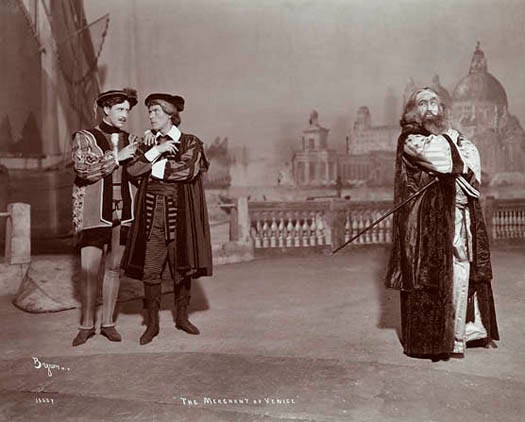
Photo: Jacob Adler, the ‘Great Eagle’ of the Yiddish theatre, in The Merchant of Venice in New York in 1903.
Add comment
Comments